


Curator’s Corner: Our Collections Team prepares for our Bright Future!
Preparations for our Bright Future building improvements continue to generate excitement, and as our team tackles Interpretive Planning–working with experts and stakeholders to determine the content and delivery of our future exhibits–we’re reflecting on our vast and beautiful collections. So please enjoy this interview with Kathleen Aston, Santa Cruz Museum of Natural History’s Curator.
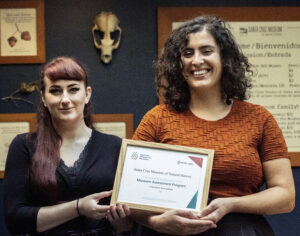
Kathleen Aston, Curator, right; Isabelle West, Collections Specialist, left.
Museum: Tell us about your history with the Museum and your current role.
Kathleen: I started as a Collections Intern. So, it’s actually been 10 years! I wanted to pursue museum studies but figured it would be hard to get a job, so I went towards a Master of Library and Information Science degree, with a focus on archives, digitization, and information management. Looking for hands-on opportunities to work with collections, I reached out to the Museum about internships. Eventually I became a Collections Specialist, then Collections Manager. And now, as Curator, I get to lead our small but mighty Collections team, helping to advance our mission.
Museum: As Curator, what are some of your primary responsibilities?
Kathleen: First and foremost, it’s about the activities that promote preservation of the physical and intellectual aspects of collections. At a granular level, it’s about devoting individual attention to a collections object, transforming it into an information-bearing object, and sharing its learnings. So, that involves inventorying, conducting gap analyses to see what information might be missing or underdeveloped, ensuring our adherence to standards for MAP (Museum Assessment Program) and CAP (Collections Assessment for Preservation), digitizing records and managing our database for efficiency and shareability—because we also loan items to other institutions and share research findings. And of course, I get to work with our exhibits team to identify and prepare items for exhibition. Everything I’ve just outlined, by the way, is supported by the Collections Team; our Collections Specialist, Isabelle, and a group of dedicated volunteers.
Museum: Wow, that’s a lot of moving parts! Soon your team will be preparing the Collection to move to a temporary location so work can begin on the building expansion. What are you doing to prepare?
Kathleen: We’re in the midst of a big inventory project, which is key to our preparation for the move. Our goal when evaluating an item is to touch it only once. So, we research the ideal packing conditions for each item, preparing it not only for the move but for storage. And the physical space available is an important factor. For instance, we have a beautiful collection of nests which will probably be one of the last things we’ll pack because they can’t be stacked; each will be in its own box. The process of repackaging them correctly will expand their footprint.
And as we assess each item, we’ll also need to do tribal outreach, to ensure duty of care compliance. That’s both an ongoing responsibility of curation and a process that has evolved in recent years due to updates in federal and state laws.
From a planning standpoint, we also have an opportunity to manage our database differently because it imagines everything in one place which is challenging in the context of the three spaces we’ll occupy in the next few years; the Museum as it is today, our temporary site, and the improved building which will include expanded collections storage.
Museum: Interesting. So, the move is highlighting unique opportunities to work differently and better. What are some of the other interesting opportunities?
Kathleen: Well, going back again to the byproducts of our inventory project; it gives staff and volunteers a chance to see and learn about items they never knew existed in our collection. So, there’s an opportunity for deeper cross-training so that all Museum employees and volunteers can speak to the depth and breadth of the collection, and figure out which is their favorite item and why. And it’s fun to celebrate each person’s special interests because that love for our collections is contagious, which is kind of the point, right?! For instance, Isabelle is an expert on our postcard collection, and I’ve seen people fall in love with a historic logging photo or a postcard poem about the loveliness of pelicans that they never knew we had because they got a chance to dig into the collection with Isabelle.
Museum: Okay, we’ve talked about your day-to-day and your preparation for the move. Now for the moment you’ve been waiting for for ten years: What aspects of the plans for our improved building excite you most?
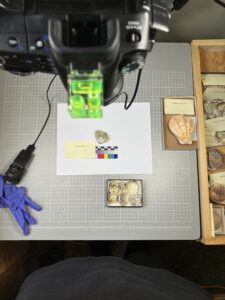
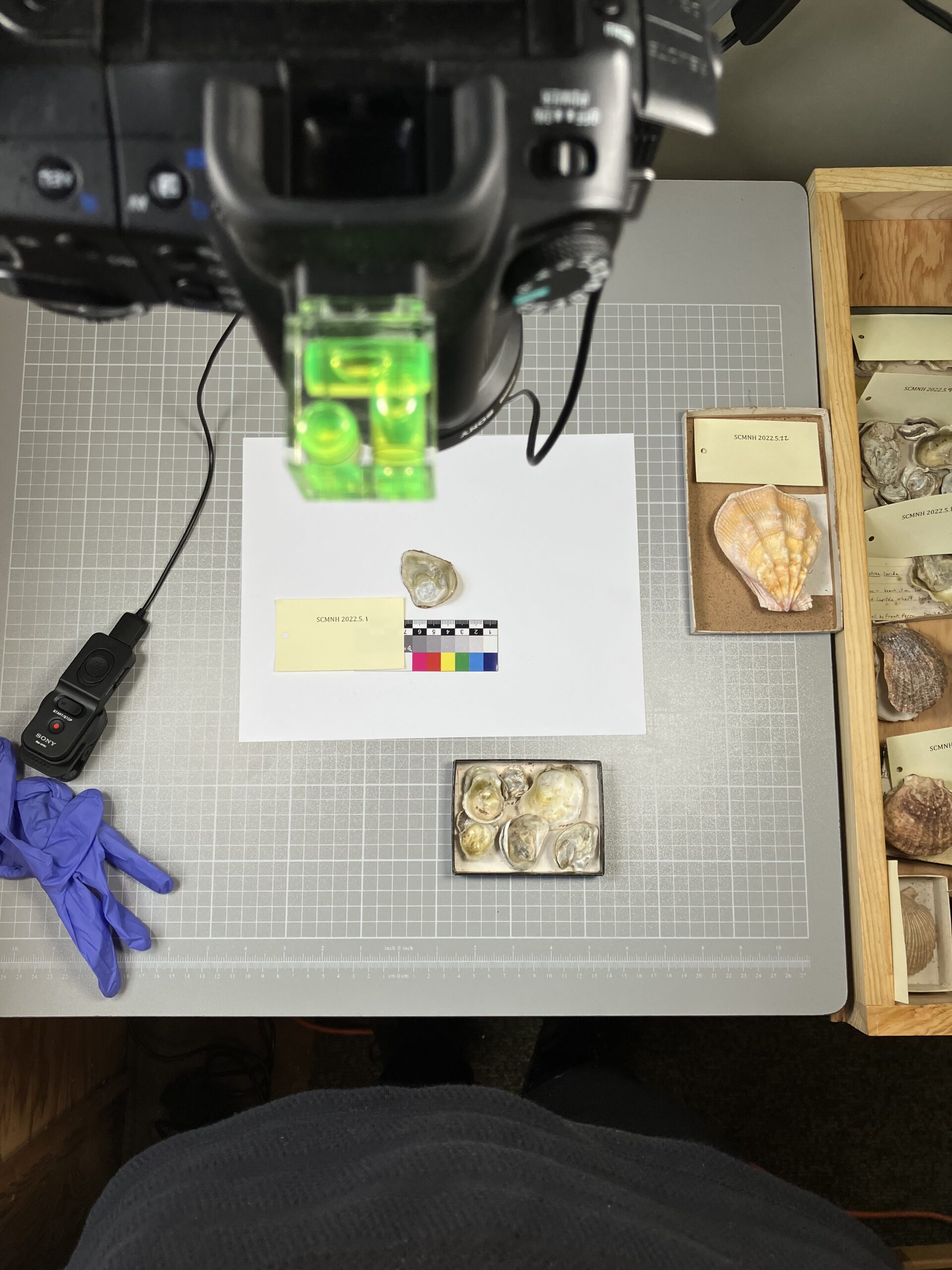
Ostrea lurida or Olympia Oyster shell being photographed for digital cataloguing.
Kathleen: So many things! As Curator, I can’t wait to have purpose-built collections storage units and a dedicated workspace. I’m really proud of our adherence to best practices of storage despite having to “DIY” much of it: We use a lot of ziplocks, and we’re meticulous about making sure everything is at least six inches above ground in case of flooding. We’re constantly monitoring humidity and protecting against the risk of pests … But when we have compact museum shelving, designed to store pieces that are highly susceptible to fluctuations in temperature and light and humidity–units that transform into various configurations depending on need–it will be a game changer. The design will also include a designated workspace for the collections team. We do, and would like to do more of, a lot of cleaning and restoration that sometimes involves chemicals and the need for a sink, for instance. I’m looking forward to the day when one team member can be working on specimen preparation while another is doing imaging for digitization; it will open a world of possibilities when we are able to work that efficiently.
And ultimately, it’s not just about efficiency—we talk about how we’ll advance our mission through the Bright Future Campaign—with the appropriate workspace, we’ll be able to engage in research that requires prepping and processing specimens, something we can’t currently do much of on site. By broadening our field of study in that way, we’ll naturally advance the mission because we’ll have more treasures and discoveries to share with our community.