


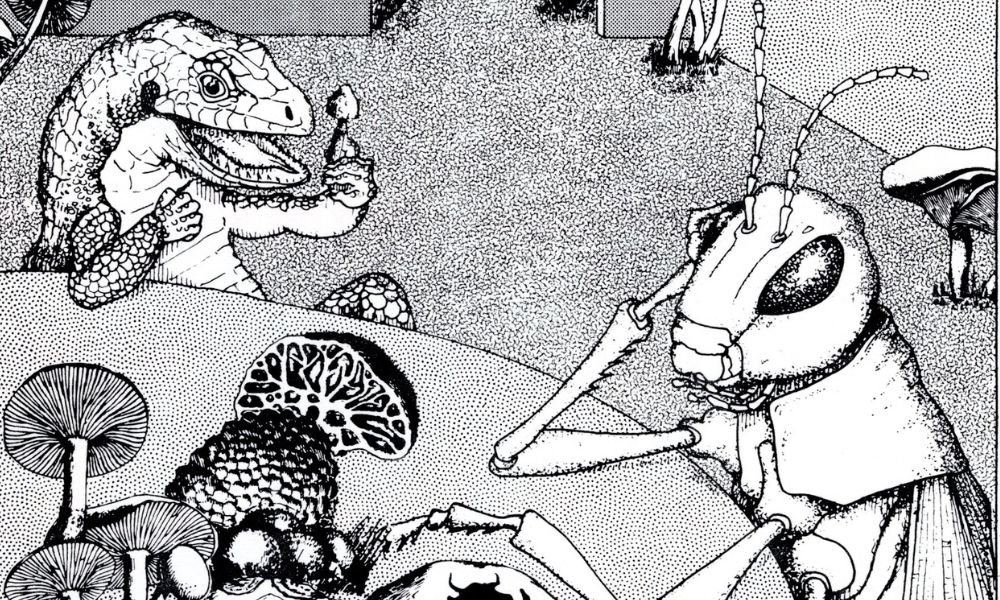
If fungi had a poster child, who would it be? A classic red capped amanita? Or maybe an exuberantly golden chanterelle? Or maybe, just maybe, it would be one of the eclectic cast of characters that has periodically adorned Fungus Fair flyers from as far back as the 1970s!
Centered in a square frame, a grasshopper (or another member of the family orthoptera) leans an “elbow” onto a table piled high with vibrant fungal forms, reaching lazily towards this treasure trove. Nearby, what appears to be an excited alligator lizard is poised to pop a mushroom in it is mouth. It’s a homey scene, but unlikely beyond the goofy trope of animals at a table. While grasshoppers, who prefer leafy green meals, will turn to fungi for food, alligator lizards might likelier eat their fellow fair guest!
Zooming out, these whimsical Fungus Fair attendees are in a series of rooms full of fungi. The specimens appear to be planted into the floor, recalling the elaborate dioramas of the fair, where a visitor might wonder how they walked through the doors of the London Nelson Center and found themselves in a forest. And while these elaborate displays have been an iconic part of the event, it hasn’t always been held at London.
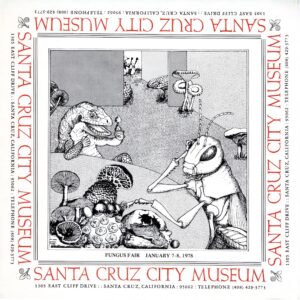
Artwork by Charles Prentiss, former Museum Curator
In fact, the first festival was held in 1974 here at your favorite local natural history museum, then called the Santa Cruz City Museum. From the beginning, it featured more than 150 varieties of wild native mushrooms, displayed in those trademark habitat dioramas with detailed identifications. Originally a joint project of the Museum, mycologist David Arora, and enthusiastic community members who would become the Fungus Federation, the event quickly grew to thousands of guests. There were even years where the very rains that supported fungal growth would cancel the tables and activities that had to spill out into Tyrrell Park.
Looking for more space, the fair moved around and eventually settled at London Nelson in the 1990s. In describing the choice of venue, longtime member and mushroom identification instructor Phil Carpenter pointed out the value of not only having more space, but of having a facility where the Federation could begin setting up displays many days ahead of time. This extra time is a critical requirement for specimen preservation and display, as Federation members are called upon to gather various specimens in the days leading up to each year’s fair.
A beloved institution for many of us, the Fungus Federation is a community organization that promotes love for and study of fungi. They welcome folks of all skill levels, from amateurs just learning what to look for, to experts helping science look more closely at the mycoflora of Santa Cruz County. In addition to educational events, workshops, and classes, they support scientific research through scholarships and grants. A federation member might be just as likely to help you learn what a particular mushroom is, as they are to advise you on how to cook it. Of course, one doesn’t always follow the other – in the words of mushroom enthusiasts, who seem equally fond of fun sayings as they are of caution – there are old mushroom hunters and there are bold mushroom hunters but there are no old bold mushroom hunters. And they don’t just put the fun in fungi, they put on the famous annual Fungus Fair!
The Federation’s knack for bringing people together over fungi extends to the robust local community of science and nature illustrators. This selection of posters highlights diverse strategies and styles used to depict the natural world, from watercolor to block printing to photo collage. Oftentimes the artists have been graduates of UCSC’s former science illustration certificate program. We were lucky enough to catch up with two of them.
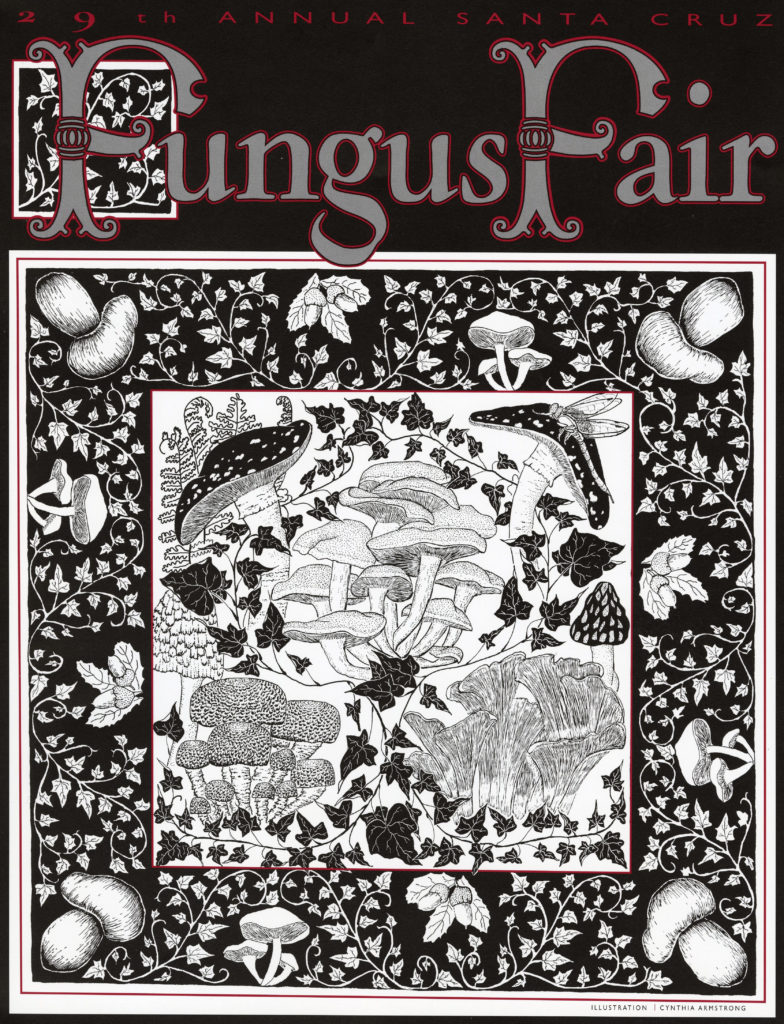 Cynthia Armstrong’s illustration for the 2003 Fungus Fair poster is a striking combination of stark contrasts and intricate detail, highlighting a variety of fungus species ensconced within a delicate network of vines. She made it not long after completing her science illustration degree, committed to pursuing a career that dovetailed her first love, science, with her lifelong creative impulses. As an artist, Cynthia loves to show her processes – the unfolding of a subject in process recalls how the scientific exploration for answers often unfolds into new questions. As a science illustrator, she has enjoyed taking part in this process across the world, whether illustrating mammoth bones in Maine’s state museum or documenting plants for a field botanist in Panama.
At home on the Central Coast, Cynthia loves that the redwoods are always full of opportunities to find fungus. The incredible diversity of fungus keeps her intrigued – their otherworldly and alien forms and structures are a joy to illustrate. She still regularly attends the Fungus Fair with her family, having first attended decades ago when fair founder David Arora was signing copies of his newly published classic, Mushrooms Demystified. You can catch Cynthia’s current work, including local classes, on her website.
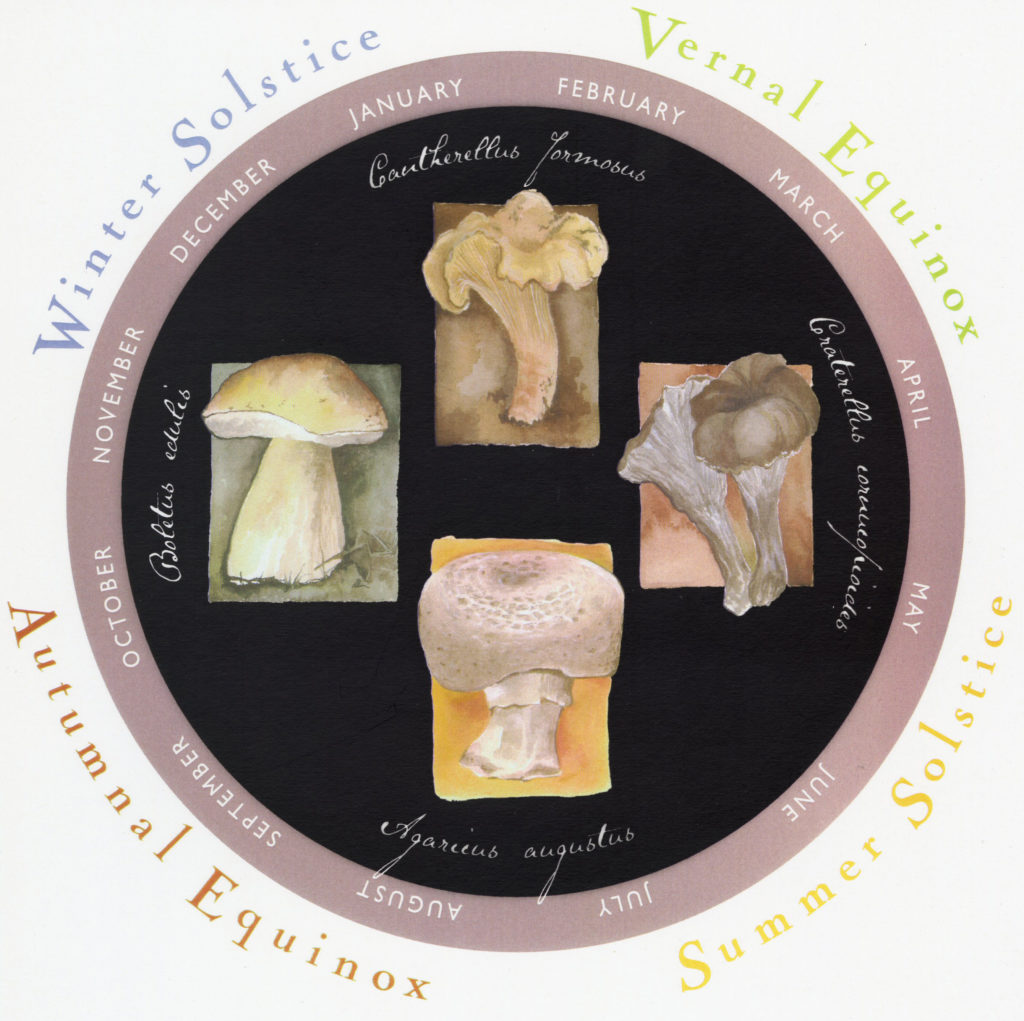
Gay Kraeger’s work for the 2004 fair poster provides another perspective: four species of dreamily watercolored fungi chart a circle in time – guiding the viewer on what season one might be most likely to find them. Gay actually created this image years before she formally got into illustration. Her neighbors at the time, Fungus Federation members who were in the habit of hosting parties with delicious food, asked her to help illustrate a fungi cookbook they were putting together. Gay was happy to help – she’d always been in engaged with art, and natural history is her favorite subject.
 Today her career continues to bring together these interests: on the one hand she teaches illustrated watercoloring journaling. Her own journaling entries are stunning. She loves to see people become more excited and aware of the world as they build the confidence to draw it. On the other hand, she and her business partner Holly Reed run an interpretive design firm called Wildways Illustrated. You can see their work all over the state, but locally they’ve contributed to signage and exhibits at places like Natural Bridges, Ano Nuevo, and the Boardwalk. She’s excited to be working on a welcome panel for Henry Cowell, where park staff made sure to request a turkey tail fungus (Trametes versicolor) as a primary feature.